| Психология | Соматология | Математика | Физика | Химия | Наука Общая лексика |
| А | Б | В | Г | Д | Е | Ж | З | И | К | Л | М | Н | О | П | Р | С | Т | У | Ф | Х | Ц | Ч | Ш | Щ | Э | Ю | Я |
| A | B | C | D | E | F | G | H | I | J | K | L | M | N | O | P | Q | R | S | T | U | V | W | X | Y | Z |
|
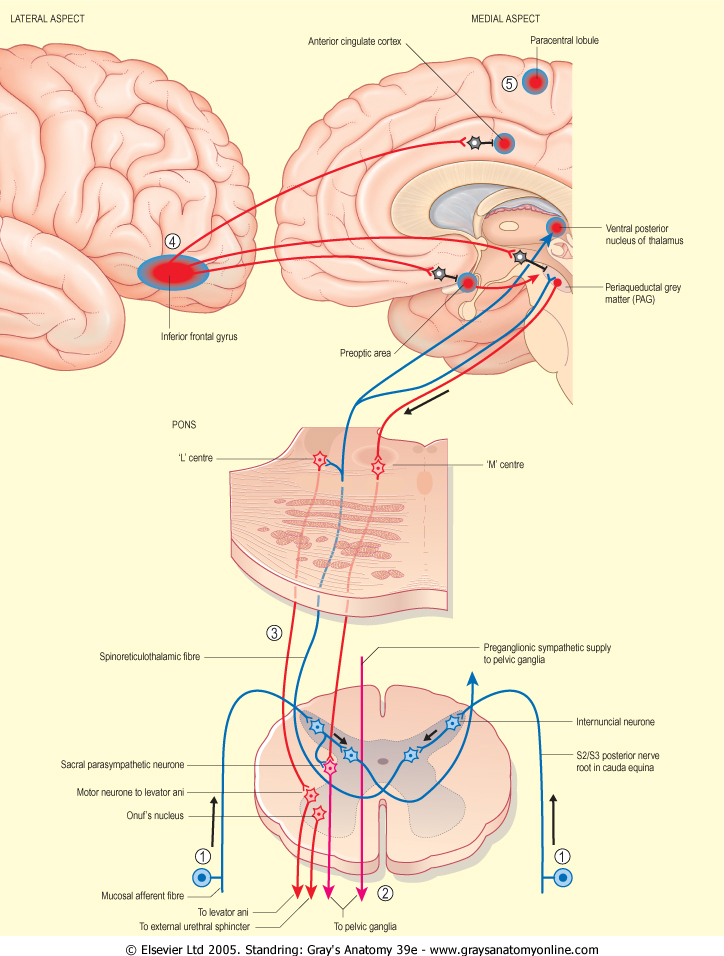
Схема. Управление мочевыведением.
Figure 93.4 Control of micturition. The micturition control centre is in the paramedian pontine reticular formation on each side. It comprises a medially placed micturition centre, 'M' and laterally placed storage centre, 'L'. Neurones project from the 'M' centre and to the storage centre 'L' to parasympathetic neurones in segments 2-4 of the sacral spinal cord, and to Onuf's nucleus, which is in the same segments, and which innervates the external urethral sphincter. At higher levels, neurones in the right prefrontal and anterior cingulate cortex, right preoptic nucleus and periaqueductal grey matter, are involved in the control of micturition. Vesical afferents from stretch receptors in the detrusor and trigonal mucosa relay the extent of bladder filling to the brain stem and thalamus via spinoreticulothalamic fibres (1). Activity in the sympathetic system that maintains bladder compliance increases (via ?2 receptors detrusor fibres) and parasympathetic activity is inhibited (2). Spinoreticular fibres synapsing in the 'L' nucleus in the pons activate Onuf's nucleus to increase the tone of the external sphincter (3). If micturition is deferred, fibres projecting from the inferior frontal gyrus inhibit the right anterior cingulate gyrus, preoptic area and periaqueductal grey matter) (4). Voluntary contraction of the pelvic floor musculature, controlled by the prefrontal cortex driving the perineal 'area' of the motor cortex (5) cannot be long sustained once filling is complete. (By permission from FitzGerald MJT, Folan-Curren J 2001 Clinical Neuroanatomy, 4th edn. London: Saunders.)
|
|||||||
Санкт-Петербург, Россия, 1996-2015
Разрешается некоммерческое цитирование материалов данной энциклопедии при условии
полного указания источника заимствования: имени автора, названия и WEB-адреcа данной энциклопедии
| Автор | Новые идеи | Индекс | Библиотека | Поиск | Отзывы | Ссылка | Пожертвования | Параллельный сайт |
Всего посетителей = Altogether Visitors :
Посетителей раздела «Соматология» = Visitors of section «Somatlogy» : |